
Analogical thinking: generating breakthroughs from the familiar
December 17, 202501 Start by "Tweaking": Unlocking Creativity with the SCAMPER Tool
In the process of driving corporate innovation, we often encounter a realistic problem: how to generate new growth ideas despite limited resources and predetermined paths. At such times, rather than engaging in empty talk about "disruptive innovation," we need a practical method to help teams break out of inertial thinking and achieve directional, bounded breakthroughs within existing products, processes, or models. SCAMPER is exactly the tool for this purpose—it guides us in a structured way to extract new possibilities from familiar things.
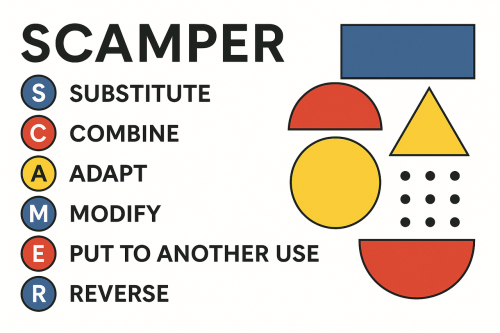
SCAMPER is not a complex methodology, but a heuristic tool composed of seven basic thinking directions. Its name is an acronym derived from the first letters of seven key verbs: Substitute, Combine, Adapt, Modify, Put to other use, Eliminate, and Reverse/Rearrange. Each dimension challenges the existing solution, helping us step outside default assumptions to examine the problem from different angles.
In practice, this tool is not only used for product and service design but is also frequently applied to process optimization, brand communication, operating models, and even the reimagining of organizational mechanisms. Its advantages lie in being simple, direct, and broadly applicable, making it suitable for the divergent phase of almost any innovation initiative.
Take "Put to other use" as an example. Rattan fruit baskets produced by manufacturers were, without any modification, widely used by consumers as "cat beds." This scenario migration did not change the product itself, yet the new usage sparked a brand-new value perception and drove secondary content distribution. Upon observing this trend, companies adjusted their product displays and marketing language accordingly. This embodies the core spirit of "Put to other use" in SCAMPER: redefining the usage scenario of an object can potentially open up new audience groups or market entry points.
Next, let's look at the "Reverse" mindset. For a long time, furniture products followed the traditional logic of "factory pre-assembly and whole-unit shipping." However, IKEA went the opposite way, reversing the process to "modular flat-packing and user home assembly." This drastically reduced transportation and warehousing costs. While this adjustment seemed like a mere change in process sequence, it actually brought comprehensive impacts to the business model, supply chain, and pricing strategy, becoming the foundation for IKEA’s ability to offer design-led products at low prices.
Similarly, consider Genki Forest replacing high-sugar formulas in traditional beverages with erythritol (S - Substitute), McDonald's eliminating plastic straws in favor of strawless lids (E - Eliminate), or the optimization of food packaging into single-serving portions (M - Modify). These seemingly "minor tweaks" are all results of applying different dimensions of SCAMPER.
Of course, SCAMPER is not a "panacea" for all problems. It is best suited for scenarios where you need to make structural breakthroughs starting from an existing foundation within a familiar field. When facing highly uncertain strategic innovation tasks with no clear direction, it is still necessary to combine it with methods like Jobs to be Done (JTBD), Design Thinking, or Blue Ocean Strategy. However, in the starting phase of innovation, using SCAMPER for a systematic divergence of thought can significantly improve the quality of discussion and depth of thinking within a team.
Innovation does not always mean drastic, sweeping changes. Often, truly effective change comes from the fine-tuning and reconstruction of original structures. SCAMPER provides a path to "leverage small changes for big impact," allowing us to find new combinations and new logic on an existing basis, thereby creating new value.