

Launch letter | InnoSeeker: take the risk out of innovation
December 30, 2025
Is the goal of innovation merely to reduce failure rates?
December 30, 2025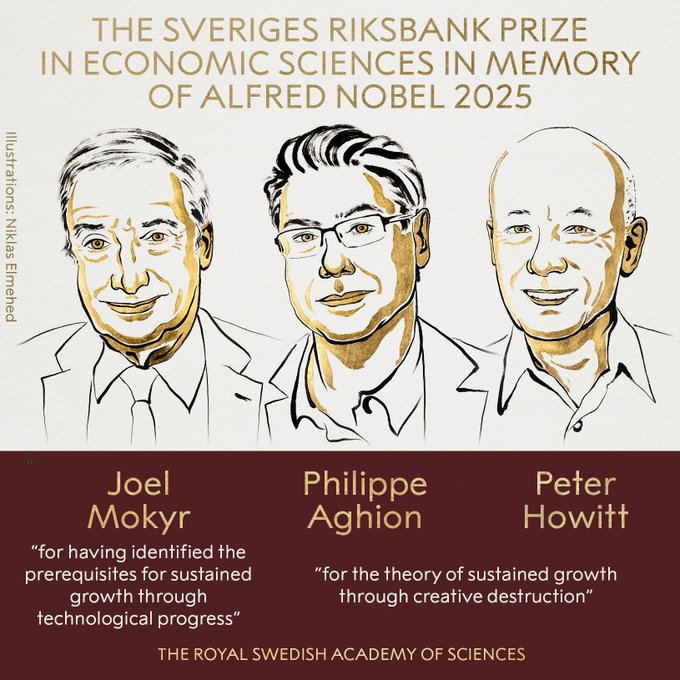
Abstract: At a time when global technological change is accelerating and the pressures of industrial restructuring and institutional shifts are becoming increasingly complex, the Nobel Committee’s decision to award the prize based on the theme of “Innovation and Creative Destruction” is a symbol in itself: Innovation is no longer just the mission of entrepreneurs; it is a test for institution designers.
Introduction: When Innovation Becomes an Institutional Test
The 2025 Nobel Prize in Economics has been awarded to three scholars—Joel Mokyr, Philippe Aghion, and Peter Howitt—in recognition of their outstanding contributions to the study of “Innovation-driven Economic Growth” and the mechanisms of “Creative Destruction.”
In the current landscape of accelerating global technological transformation and complex institutional pressures, this award serves as a potent symbol. It signals that innovation has transcended the realm of business execution to become a critical challenge for those who design our economic systems.
This article interprets the ideological implications behind this Nobel Prize from four perspectives:
- The theoretical origins and realistic logic of Creative Destruction.
- The key contributions of Mokyr and the Aghion-Howitt duo.
- Implications for China’s innovation policymakers and entrepreneurs.
Creative Destruction: The “Violent Aesthetics” of Economic Growth
The concept of “Creative Destruction” was first proposed by Austrian economist Joseph A. Schumpeter in 1942. Schumpeter argued that the essence of capitalism is not stable growth, but rather self-renewal through innovation and regeneration amidst destruction.
He wrote: “The storm of capitalism is continuous creative destruction—the dissolution of the old order is precisely the birth of the new.”
Under this logic, innovation brings not only efficiency gains and product diversity but also the collapse of old industries, obsolete technologies, and even antiquated institutions. It is the “metabolism” of an economy and a structural shock to society.
However, this “destruction” is never gentle. It implies: ➤ Certain professions and skills will become obsolete; ➤ Specific regions and industries will fall into recession; ➤ The dividends of new technology are not automatically distributed fairly.
Therefore, making destruction bearable and innovation sustainable has become the core institutional question of the 21st century.
Contributions of the Three Laureates: The Innovation Triangle of History, Models, and Institutions
Joel Mokyr: The Deep Coupling of Technological History and Institutional Culture
From the perspective of economic history, Mokyr proposes that for technological progress to translate into sustained growth, it depends on a society’s “Culture of Innovation” and institutional inclusiveness.
He points out that Europe led the Industrial Revolution not merely because of technical geniuses, but because its society simultaneously possessed three capabilities:
- The Cumulative Interaction of Science and Technology: A positive feedback loop between scientific inquiry and practical technology.
- Mechanical Competence: A society-wide mastery of technical application and manufacturing capabilities.
- Institutional Tolerance for Change: A society that allows trial and error, accepts failure, and protects ideas and property rights.
In Mokyr’s theory, innovation is not just a technological event, but a product of institutions and culture. Without institutional tolerance, innovators have nowhere to grow.
Philippe Aghion & Peter Howitt: Architects of the “Growth via Destruction” Model
Aghion and Howitt developed the theoretical framework known as the Schumpeterian Growth Model, transforming “Creative Destruction” from a philosophical concept into a calculable economic model.
Their core ideas include:
- Innovation is Endogenous: Technological progress is not an external variable but is driven by the investment decisions of enterprises, researchers, and entrepreneurs.
- Every Innovation Destroys Old Monopolies: New technologies replace old ones. Innovators gain temporary monopoly profits, while old firms are eliminated. This “destructive substitution” is the prime mover of growth.
- Institutions and Competition Policy Determine the Speed of Innovation: Innovation incentives are strongest when competition is moderate, property rights are clear, and financial markets are effective. Conversely, excessive monopoly or policy protectionism freezes the cycle of creative destruction.
- Long-term Growth in Dynamic Equilibrium: The economy achieves sustainable growth through a continuous cycle of “Innovation—Destruction—Re-innovation.”
Their theories turned creative destruction into a dynamic mechanism that can be simulated by policy and utilized strategically by businesses, laying the mathematical foundation for modern “Innovation Economics.”
Implications for China’s Innovation Policymakers and Entrepreneurs
China is at a critical inflection point, moving from “Manufacturing-driven” to “Innovation-driven.” The insights from this Nobel Prize apply as much to policymakers as they do to the spirit of entrepreneurship.
1. The Core Institutional Proposition: Make Destruction the Engine of Growth When promoting emerging fields like AI, new energy, biotechnology, and low-carbon manufacturing, the policy goal should not merely be to “support new industries” but to allow the natural exit of old ones. If policies emphasize “supporting the new” while avoiding “removing the old,” resource allocation will rigidify, and innovation dividends will be stifled. Institutions must use taxation, capital flow, and exit mechanisms to allow innovators to challenge vested interests, making destruction a natural process of economic metabolism.
2. Key Policy Design: Make Failure More Bearable The flip side of innovation is failure. Excessive administrative penalties, reputational stains, or financing blockades will make entrepreneurs “fear failure and innovate less.” Institutions should support risk-taking through entrepreneurship protection, research risk funds, and support for serial entrepreneurs. In other words, institutions should not punish failure, but rather punish the failure to attempt.
3. Strategic Choice for Entrepreneurs: Actively Disrupt Yourself For companies, the greatest danger is not the competitor, but reliance on old models. True innovators must possess the courage for “self-destruction”: ➤ Proactively launch alternative products; ➤ Reconstruct business models; ➤ Reshape old profit structures with new value chains.
As Aghion said: “The innovator’s greatest enemy is their own success of yesterday.” Only by forming a continuous cycle of “internal creative destruction” can Chinese entrepreneurs avoid being passively eliminated in the next cycle.
4. Long-term Layout for Society and Education: Cultivating a “Destructible Mindset” The root of innovation culture lies in education. For China’s innovation ecosystem to prosper in the long term, the education system needs to encourage questioning, inquiry, and interdisciplinary learning, rather than merely training for standard answers. Today, as the path of imitative innovation narrows, we must lay the groundwork in society and education. The future of Chinese innovation lies not in technological progress and low costs, but in collaborative development driven by open minds.
Conclusion: Reshaping Order Amidst Destruction
The 2025 Nobel Prize in Economics is both a retrospective and a reminder—
Innovation requires the soil of institutions; innovation also requires the courage for competition and destruction. By building an economic and social system that allows for destruction, excels at reconstruction, and learns continuously, we can turn creative destruction into a real force propelling China’s economy toward a sustained leap into the future.